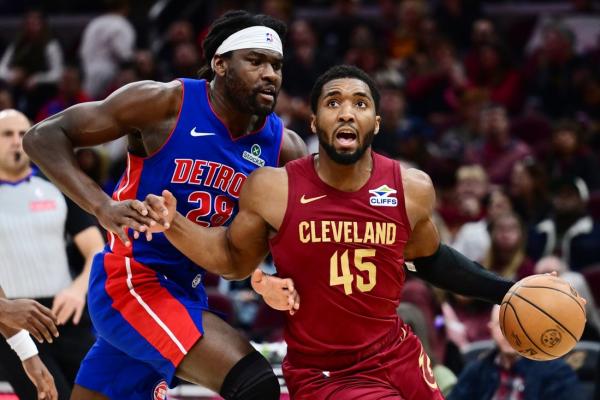
J.B. Bickerstaff spent four-plus years building Cleveland into a contender. Now he gets to try to dismantle it.
Just two days after surviving a Game 7, the top-seeded Detroit Pistons open the Eastern Conference semifinals Tuesday night at home against the fourth-seeded Cleveland Cavaliers, the franchise that fired Bickerstaff two years ago.
The Cavaliers have won the last three playoff series between the teams and carry a 12-game postseason winning streak against Detroit. But with both sides coming off Game 7s, this one may come down to which team recovers fastest.
Detroit advanced with a 116-94 win over Orlando on Sunday, fueled by 32 points and 12 assists from Cade Cunningham and 30 points from Tobias Harris.
“I know a lot of people would’ve liked it to just be easier, but I think it was great for our guys; to go through what they went through, to understand what it looks like and where they have to be in order to get it done,” said Bickerstaff, who received a contract extension on Monday. “We understand that now, and we (will) take that with us to the second round.”
Cleveland also needed seven games to defeat Toronto. The Cavs beat the Raptors 114-102 Sunday behind 22 points and 19 rebounds from Jarrett Allen and 22 points from Donovan Mitchell.
Cavaliers coach Kenny Atkinson, who replaced Bickerstaff in May 2024, expects a similar grind.
“I think a lot of similarities. Physicality, right?” Atkinson said when asked what he expects. “We’re going to have to be mentally and physically tough to beat this team.
“They’ve had a great year. They’re the favorites. We go in there as underdogs, which is a challenge. I think it’s going to be a similar series (to the Toronto matchup), being able to handle their pressure, their rebounding, their force, their physicality.”
The Pistons were among the league’s best at protecting the paint during the regular season, limiting both attempts at the rim and efficiency once opponents got there. That carried into the first round, where they forced Orlando into difficult half-court possessions, including a 19-point second half in Game 6.
That approach could create problems for the Cavaliers, especially Mitchell. Toronto had success crowding driving lanes and turning him into a perimeter scorer, and the Cavaliers’ offense stalled at times as a result.
Detroit doesn’t have a single defender like Toronto’s Scottie Barnes, but makes up for it with collective physicality. If the Pistons can replicate that formula, Cleveland could again find itself grinding on offense.
“They’ve been phenomenal,” said Mitchell, who averaged 23.1 points per game against the Raptors. “(Bickerstaff has) done a phenomenal job over there. They’ve been phenomenal all year. They’re tough, right? They’re physical. They’ve got Cade, who’s the head of the snake.
“It’s going to be a tall task. … We got to go out there and find a way to get one on the road.”
On the other end, Detroit faces its own questions. The Pistons have leaned heavily on Cunningham all season, and that dependence showed in the first round when their half-court offense stalled.
Cunningham delivered in three elimination games by averaging 36.3 points per game, but sustaining that level against Cleveland’s defense is another challenge. The Cavaliers have multiple options to throw at him, including Dean Wade, who has handled tough assignments throughout the postseason.
If Cleveland can limit Cunningham’s impact as both a scorer and facilitator, the pressure shifts to Detroit’s supporting cast, which has been productive but inconsistent as secondary creators.